Allegheny Wells
Straight ManAllegheny Wells is a small community on the wooded hills beyond Railton, comprising a compact village and nearby residential developments. For university employees, it offers a measure of privacy and distance from town, but not true escape: Railton remains close enough to shape the landscape, the residents’ work, and their feelings about the lives they have made. The area’s houses and roads become the setting for both domestic refuge and the anxieties that refuge cannot keep out.
Setting and Layout
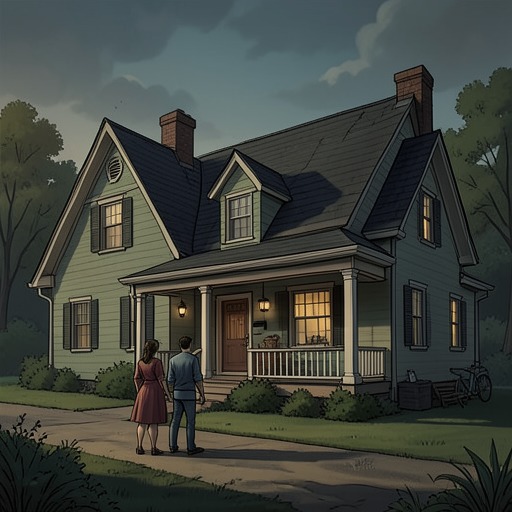
The Devereaux home stands near the top of a long, winding, tree-lined incline. Below it, roughly half a dozen larger houses are set among the trees; their owners include senior professors, administrators, and a coach. In summer, foliage screens one house from another, giving the hill a sense of solitude. The separation is incomplete, however: cars glint between trees, lit windows show through the leaves at night, and voices carry from open kitchen windows. From late autumn through winter, bare trees make the neighboring houses more visible, and residents exchange apologetic waves as they come and go, take out rubbish, or clear snow from their decks. In April, they look forward to the return of the leafy cover and the privacy that drew them there.
The Devereauxs bought the first lot in their development nearly twenty years earlier, using the advance for William Henry Devereaux, Jr.’s novel as the down payment on the land and construction. Their choice of landscaping set their property apart from those that followed: they removed most of the trees and planted grass. Lily, who grew up in a dark Philadelphia neighborhood, wanted light, long lawns, decks at both the front and back, and ample patio furniture. The furniture spends seven months of the year in the garage, but the deck remains a favored place to sit. The cleared lot also means fewer insects than neighbors farther down the hill and across the road contend with; those neighbors retreat indoors when the sun drops behind the trees.
The Village and Routes to Railton
About a mile up the blacktop from the Devereaux home lies Allegheny Wells proper, a village of about twenty houses, roughly the same size as each of the two Allegheny Estates developments. Most of its homes are small, two-bedroom raised ranches, clustered around the village’s only intersection and a steepled Presbyterian church. The church’s belfry lights come on at dusk, but its front door is padlocked outside services. The village is a destination for Devereaux on an evening run: after considering a short loop around the church, he continues uphill toward his daughter’s house.
The routes from the hill reflect different orientations toward Railton. Lily runs toward town, choosing a prettier, flatter course; Devereaux runs away from it, reasoning that a person who has moved to the country need not jog back toward the town left behind. His interpretation of Lily’s choice is informed by her work as a teacher in the public secondary schools. Rather than using her seniority to seek a lighter load or a more privileged teaching assignment, she teaches students other teachers dismiss as low-track. For Lily, their light, airy house is a temporary refuge between days of work in the community. Devereaux imagines that she can see Railton from the crest of her route, though he admits he does not know how far she runs.
Devereaux’s own route expresses less confidence in the move. He understands the four-mile distance from Railton as a retreat that stops short of leaving the town altogether. When the wind is right, dark, ashy residue from town reaches the surrounding hills. He continues farther into the woods, imagining the green landscape extending toward Canada, a contrast to the industrial town below. Allegheny Wells is therefore neither wholly separate from Railton nor free of its influence: the view and the road offer distance, while the town’s effects remain perceptible.
Homes, Neighbors, and Aspirations
The residential developments bring university colleagues into proximity outside the institution. When Orshee asks Devereaux about living among the trees, he explains that he and his partner have considered houses there. Orshee is attracted to the setting but worries that moving would conflict with their hope of living in an integrated neighborhood. The decision is also entangled with uncertainty about university layoffs: he asks Devereaux to share anything he hears, while June regards Allegheny Wells as a sound investment and has tried to persuade Teddy Barnes to buy there. The community’s appeal is thus both practical and contested, shaped by housing, employment risk, and competing ideas about where to build a life.
The hills also contain a stark contrast between the established Devereaux home and the new house built by Julie Devereaux and Russell. Their property is uphill from the village, but the construction has stalled. On Devereaux’s first run past it, the unpaved driveway, bare lot, unshuttered windows, unfinished swimming-pool excavation, and tarp over the chimney signal that the couple have exhausted their money and the bank’s confidence. The house’s resemblance to his own makes their predicament feel uncomfortably close to home. Its incomplete state is not merely a local eyesore: it turns the family’s financial strain into a visible feature of the landscape.
The same house looks more forlorn in daylight, when its dark windows and unfinished exterior are set against Julie’s small car in a double garage built to hold much larger vehicles. Later, Devereaux considers the property’s likely sale and the work that might be needed to make it marketable: shutters, minimal landscaping, filling the pool hole, and reseeding the lawn. He and Lily would have to decide whether to sell it as it stands or spend more money finishing it, even as eight or ten houses are already for sale in their own development. Allegheny Wells offers space and privacy, but those advantages do not shield its residents from debt or a difficult housing market.
Domestic Refuge and Shared Disquiet
The Devereaux deck is a place where the couple’s ordinary compatibility becomes visible. After classes end, they expect long summer evenings outside, reading or talking over chilled white wine until the quiet and darkness make them sleepy. Earlier in their marriage, they sometimes made love outdoors; by middle age, the plastic furniture and the prospect of being discovered have turned that memory into something more comic than romantic. The deck marks a domestic life that has endured, but also changed. Its seasonal use gives the couple a recurring ritual even as the text registers how time alters intimacy.
Allegheny Wells is also where Devereaux brings his unease about Julie and Russell into the orbit of family life. Lily warns him not to interfere in their affairs, and he broadly accepts the principle, although he believes it should have been obvious that the couple could not afford their house. Once it becomes clear that Julie will have to sell it, he expects Lily and Julie to settle the decision and assigns himself the practical task of working out how an unfinished property might be sold. The location ties parental concern to concrete obligations: the road uphill leads not only to a troubling sight but toward decisions about money and responsibility.
In a later moment of reprieve, Russell follows Devereaux back to the Devereaux house in Allegheny Wells. After a shower, Devereaux finds Russell seated on the deck beside Occam, the dog asleep nearby. Rather than listen to a full answering machine or return immediately to the turmoil elsewhere in his life, Devereaux joins Russell outside and offers him a beer. The familiar deck briefly accommodates an uneasy son-in-law and father-in-law without requiring either to resolve what has brought them there. The wooded setting and the small act of hospitality give their conversation room to begin.
Narrative Significance
Allegheny Wells functions as a threshold rather than a sealed refuge. It is close enough to Railton for work, polluted air, and university disputes to remain part of daily life, yet high and wooded enough to promise separation. The hill’s changing visibility makes that promise seasonal: summer foliage conceals neighbors, while winter exposes the houses to one another. Privacy is real but conditional, and the roads continually connect the residents to the town and to each other.
The community also gathers different kinds of aspiration and disappointment into a single landscape. Its wooded developments attract university employees seeking quiet, while the village retains a more modest scale; the homes can signify investment and comfort, but Julie and Russell’s unfinished construction makes financial vulnerability unmistakable. Devereaux’s alternating choice to run away from town and to visit his daughter’s house links the geography to his own divided impulses. Allegheny Wells is at once the place where the family has built a life, a vantage point from which Railton remains visible, and a setting where the costs of that life come into view.